Publications
Books, peer-reviewed articles and government reports on project management, cost-benefit analysis, AI and infrastructure economics. Each publication has a short interactive summary with charts drawn from the verified figures, opened with “Explore findings”.
The Price of Biodiversity: Hedonic Evidence from Danish Housing Markets
Estimates how the ecological quality of nearby nature is reflected in property prices, using around 850,000 geocoded Danish home sales matched to the Biodiversitetskort, the national biodiversity map of Denmark. I have found no earlier estimate of the price of ecological quality in Danish or Scandinavian property markets. Homes near higher-quality nature sell for more, though I read most of the unadjusted price gap as a reflection of who chooses to live near nature. The bioscore is the 0 to 19 index of ecological quality in the Biodiversitetskort. Among homes of the same type within the same parish, a one-point higher average bioscore within 1 kilometre of the home is associated with about 2.8 percent higher prices, or DKK 57,500 at the median sale price of DKK 2 million. Homes of the same type in the same parish typically differ by about half a point. One standard deviation of that within-parish variation, 0.56 points, is associated with about 1.6 percent higher prices, or DKK 32,000. A link to the paper will be added when it is released.
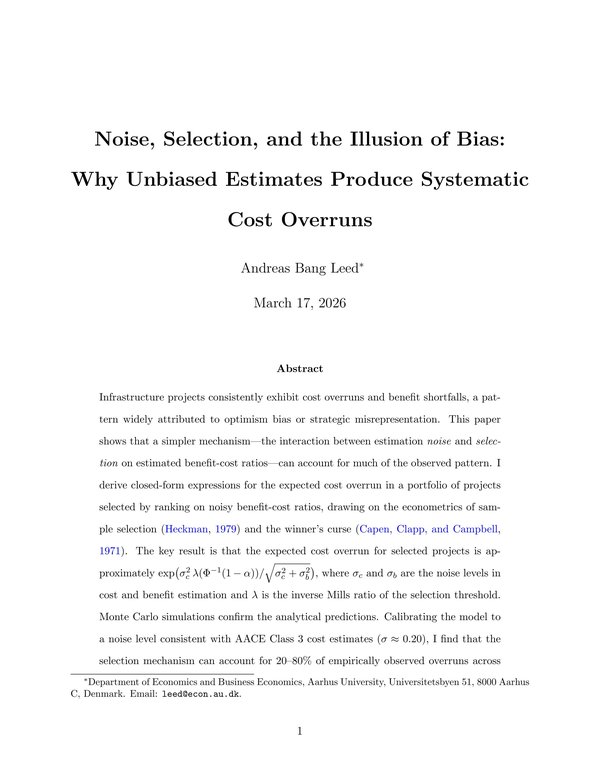
Noise, Selection, and the Illusion of Bias: How Unbiased Estimates Can Produce Systematic Cost Overruns
Shows that estimation noise combined with project selection based on the benefit-cost ratio can account for roughly 25 to 50% of observed infrastructure cost overruns across most categories, a central reading near a third, even when each estimate is unbiased. This portfolio version of the optimizer's curse is derived in closed form and calibrated to international data across eight project types. A revised version is in preparation. The figures shown here reflect the current draft, which is ahead of the posted SSRN paper.
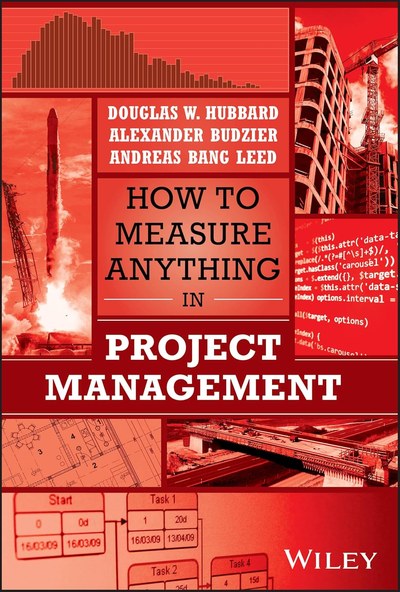
How to Measure Anything in Project Management
This practical guide to evidence-based project decisions uses outcome data from thousands of completed projects to replace intuition with measurement, covering calibrated estimation, Monte Carlo simulation, reference class forecasting and the expected value of information. Its findings include that qualitative risk matrices can add error of their own and that even simple quantitative models tend to outperform unaided expert intuition.

Maintaining Capital Discipline in the Rush to Net-Zero Energy Systems
Examines how the urgency of the energy transition can lead to weakened cost controls on capital projects. Using evidence from large-scale energy infrastructure, the paper argues for maintaining rigorous capital discipline even as investment accelerates towards net-zero targets. Across more than 1,100 clean-energy projects, mean capital-cost overruns run 84% above estimate, and 36% for projects completed since 2000.

AI in Action: How the Hong Kong Development Bureau Built the Project Supervision System
Documents the design and deployment of an AI-powered early warning system that monitors the active projects in Hong Kong's public-works portfolio. The system uses machine learning to detect signals of cost overrun and schedule delay, enabling proactive intervention by the government. The current version predicts cost overruns with 91% accuracy, and 80% of its cost forecasts land within ±10%.

Updating the Evidence Behind the Optimism Bias Uplifts for Transport Appraisals
Commissioned by the UK Government, this report updates the empirical evidence underlying the optimism bias uplifts used in transport project appraisals. At the Full Business Case stage and 80% confidence, the recommended capital-cost uplift is 60% for rail and 47% for roads. The analysis informed policy guidance that shapes how billions of pounds of public investment are appraised.
Quantitative Cost and Schedule Risk Analysis of Nuclear Waste Storage
Applies quantitative risk analysis methods to nuclear waste storage and decommissioning projects. Using reference class forecasting and Monte Carlo simulation, the paper demonstrates how to produce calibrated cost and schedule estimates for highly uncertain megaprojects. At an 80 percent confidence level the required cost uplift, the amount added to the base estimate, is 202 percent, far above the official contingencies of 23 to 51 percent.
Practitioner Articles
How to Measure Your Projects More Effectively
Five practical tips for getting project measurement right: start with decisions not dashboards, beware the analysis placebo, embrace uncertainty through probability, measure what matters not what is easy, and test your methods. When experts say they are 90% certain, they are often right only 40 to 50% of the time.
Interested in Collaborating?
I am always open to research collaboration, media enquiries and speaking opportunities.